How WebSockets Work
WebSockets replace repeated request-response cycles with a long-lived duplex channel
Standard HTTP is excellent for discrete requests, but less natural for high-frequency back-and-forth communication. WebSockets solve that by establishing a persistent connection that both sides can use to send messages whenever needed.
This makes them useful for chat, collaboration tools, dashboards, multiplayer games, notifications, and streaming application events.
Last updated: May 11, 2026
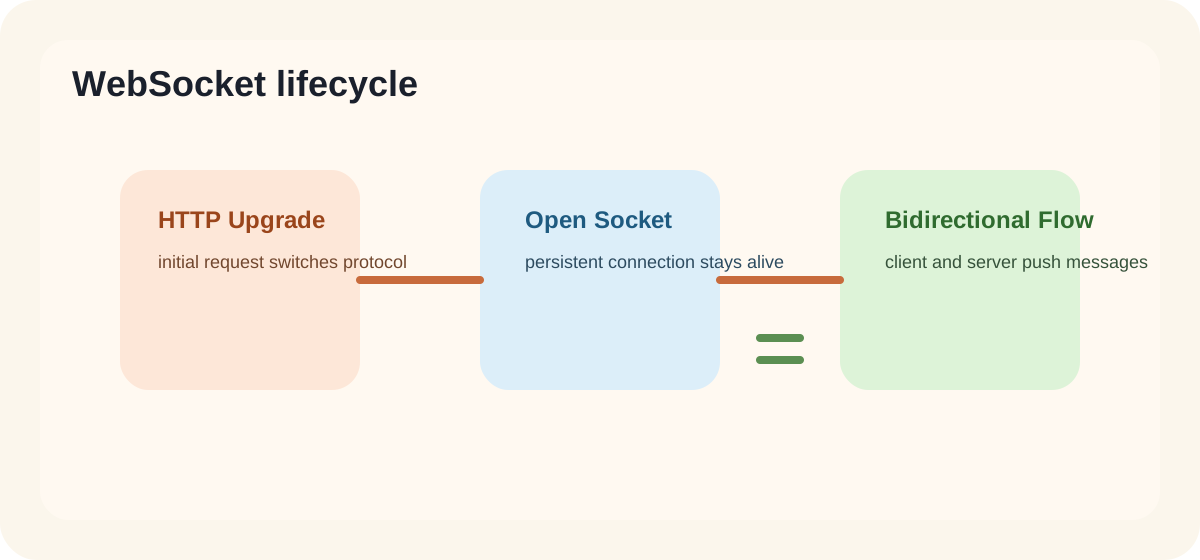
How the connection starts
A WebSocket session usually begins as an HTTP request. The client asks to upgrade the connection protocol, and if the server agrees, the same underlying TCP connection becomes a WebSocket channel.
What changes after the upgrade
Instead of separate HTTP requests and responses, both sides send framed messages over the open connection. The server no longer has to wait for the client to initiate every exchange.
What a message lifecycle looks like
After the connection is open, the client may subscribe to a topic, join a room, or authenticate the socket session. The server can then push updates whenever underlying state changes. In a collaborative app, that might mean typing indicators, cursor positions, presence updates, or fresh document patches being sent without a new request each time.
Why teams use WebSockets
- Lower overhead than repeated polling for frequent updates.
- Server-initiated pushes are straightforward.
- The interaction model matches real-time product behavior more closely.
Operational tradeoffs
Long-lived connections consume resources on the server and intermediate infrastructure. Scaling them well often requires connection-aware load balancing, heartbeat handling, reconnect logic, and careful state design.
Heartbeats, reconnects, and offline handling
A production WebSocket feature usually needs more than opening a socket once. Clients must detect dropped connections, retry with backoff, restore subscriptions, and decide what to do when the app goes offline temporarily. Those behaviors are part of the real system design, not edge polish.
Common confusion
- WebSockets are not automatically better than HTTP for every feature.
- A persistent connection still needs authentication and authorization controls.
- Realtime UX often also needs retry and offline handling on top of the socket layer.
When plain HTTP is still enough
If updates are infrequent, polling or server-sent events may be simpler to operate. WebSockets are most compelling when the product truly benefits from ongoing two-way communication. Choosing them too early can add infrastructure complexity without much user benefit.