How Transformers Work
Transformers learn which parts of a sequence matter to each other
A transformer starts by converting text into tokens and then into vectors called embeddings. Layers of the model repeatedly transform those vectors so each token representation can incorporate information from other relevant tokens in the context.
The defining mechanism is attention. Instead of keeping one compressed hidden state like an RNN, the model can directly compare positions in the sequence and decide which ones should influence each other.
Last updated: May 11, 2026
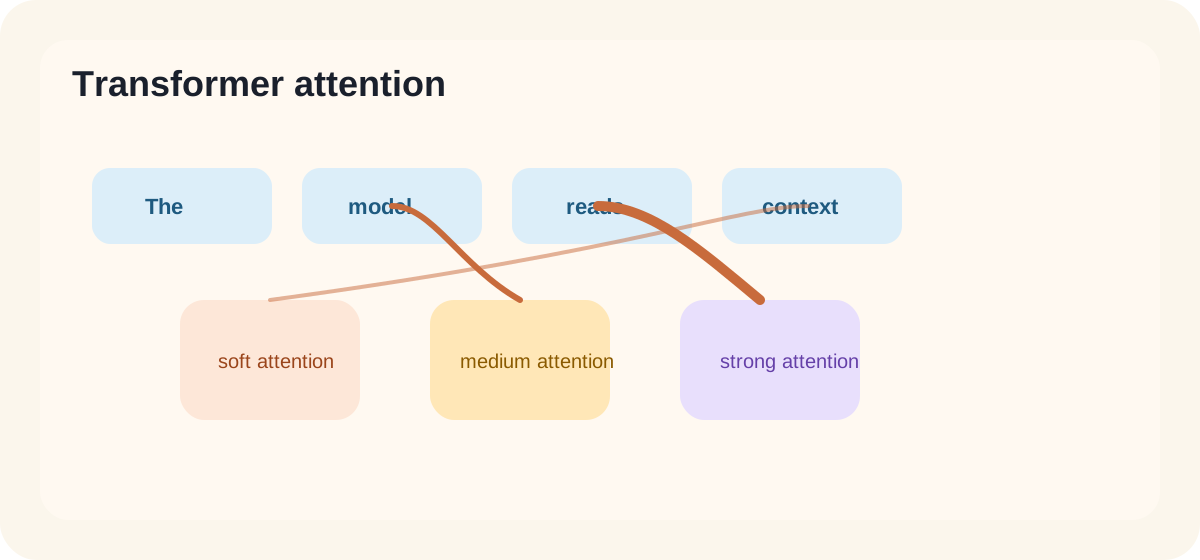
The attention idea
For each token, the model computes scores describing how much it should attend to other tokens. Higher scores mean more influence. This lets the representation for a word depend on the surrounding words that clarify its meaning.
Why tokenization matters before attention
The model never sees raw human meaning first. It sees tokens produced by a tokenizer, and those token boundaries influence everything that follows. A word, number, identifier, or code snippet may break into several tokens, which affects cost, context length, and how patterns are learned.
This is one reason prompting behavior can feel sensitive to phrasing: different wording can change the token sequence and therefore the relationships the model computes.
Why transformers scaled well
- They parallelize sequence processing better than classic recurrent models during training.
- They can model long-range relationships more directly.
- Stacking many layers and training on huge corpora produces very general representations.
What a language transformer predicts
In many language-model setups, the model is trained to predict the next token given the previous tokens. That objective sounds narrow, but at scale it forces the model to internalize syntax, semantics, world patterns, and many forms of task structure.
Training and inference are different phases
Training is the expensive phase where the model adjusts billions of parameters across huge datasets. Inference is the later phase where a fixed trained model consumes a prompt and produces output token by token. Many product behaviors people notice, such as latency or context limits, are inference-time concerns rather than signs of how the model was originally trained.
Common confusion
- Attention is not explicit symbolic reasoning; it is a learned weighting mechanism.
- The model does not read raw characters directly in the same way humans do; tokenization matters.
- A transformer architecture is a building block. The final product around it depends on training, tuning, tools, and serving systems.
Why this matters in real products
Transformers power more than chatbots. They show up in code completion, search ranking, summarization, document extraction, multimodal systems, and many retrieval or agent-style products. Understanding the architecture at a high level helps explain why context windows, latency, token budgets, and prompt structure become product constraints.