How TCP Works
Connection setup, sequence numbers, acknowledgements, retransmission, and flow control.
Read guideGuide Library
Short technical explainers on protocols, systems, and model architectures developers run into constantly.
How Things Work
These pages are written for developers who need the practical version of a concept before going deeper into specs, papers, or framework internals. The goal is to explain the moving parts clearly enough that logs, dashboards, and code make more sense.
The collection spans network transport, encryption, request handling, data systems, and modern machine learning building blocks. Each guide focuses on the core mechanism, the important vocabulary, and the mistakes people commonly make when talking about the topic.
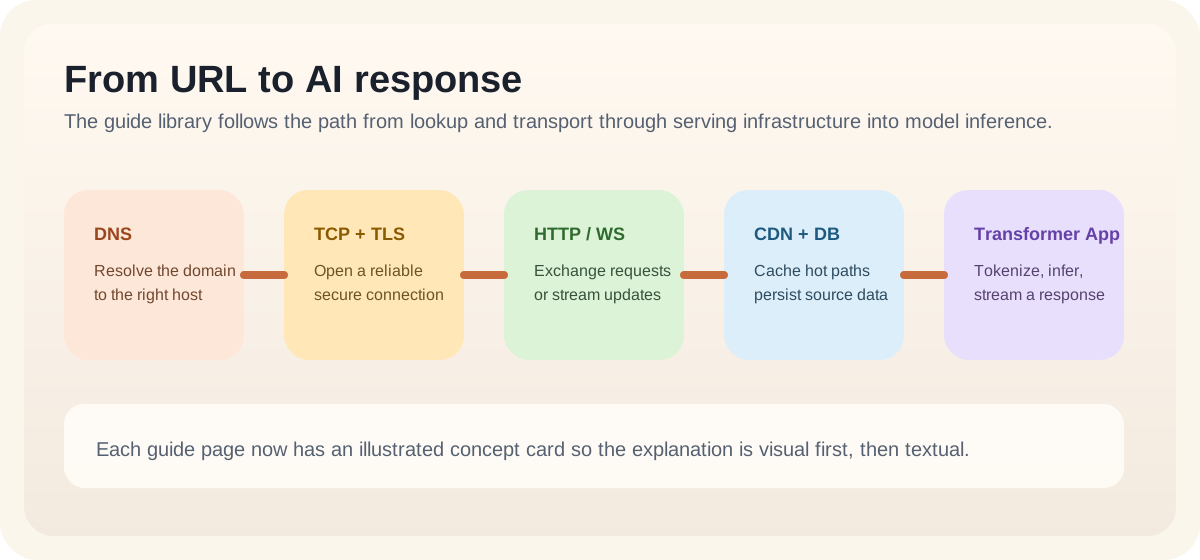
Start here if you want a better mental model for how requests move across the internet and what sits between a browser and an application server.
Connection setup, sequence numbers, acknowledgements, retransmission, and flow control.
Read guideCertificates, handshakes, session keys, and why SSL is mostly a legacy name now.
Read guideHow names become IP addresses, where caches live, and why propagation is never truly instant.
Read guideMethods, headers, status codes, request-response behavior, and statelessness.
Read guideResources, verbs, idempotency, payloads, and the practical shape of a typical API.
Read guideUpgrades, persistent connections, and when a duplex channel is better than polling.
Read guideEach page now opens with a colorful original diagram so readers can build the mental model quickly before reading the detailed sections.
These pages are meant to be read by working developers, not only students. Each guide tries to answer three questions quickly: what the system is for, what the core mechanism is, and what people commonly misunderstand when debugging or discussing it.
The format is intentionally repetitive because repetition helps readers scan: a plain-language introduction, an original diagram when useful, a breakdown of the moving parts, and a short list of common confusions. The aim is to make the page useful even if someone reads only one section while triaging an issue.
If you are following a request from the browser to the backend, or moving from classic web infrastructure into AI application behavior, these sequences are a better starting point than random article hopping.
Start with DNS, then TCP, TLS, HTTP, REST APIs, and WebSockets to understand how clients locate, connect to, and talk with services.
Start with DNSContinue with databases and CDNs to understand storage, caching, latency reduction, and the tradeoffs between freshness and speed.
Read databasesUse CNN, RNN, transformer, and ChatGPT guides together if you want a compact ladder from model families to deployed conversational systems.
Start with CNNsThey are original summaries designed to improve working intuition. They are not standards documents, legal security guidance, or exhaustive research surveys. If you need implementation details for production systems, the best next step after these pages is still the relevant RFC, vendor documentation, or research paper.
That boundary matters because the point of this guide library is to reduce confusion, not create false confidence. The ideal outcome is that a reader leaves with clearer vocabulary, a more accurate mental model, and a better sense of what to read next.
These explainers focus on the infrastructure layers that shape latency, consistency, and scale in real applications.
Storage engines, indexes, transactions, and why reads and writes behave differently.
Read guideEdge caches, cache keys, invalidation, and how content gets closer to users.
Read guideThese pages strip the topic down to the important mechanism so the common terms around deep learning are easier to decode.
Convolutions, filters, feature maps, pooling, and why CNNs were strong at image tasks.
Read guideHidden state, recurrence, sequence processing, and why long context is hard for them.
Read guideTokens, embeddings, self-attention, layers, and next-token prediction.
Read guideHow a chat product is built on top of a large language model and inference pipeline.
Read guide