How RNNs Work
RNNs read sequences one step at a time and keep a running memory of what they have seen
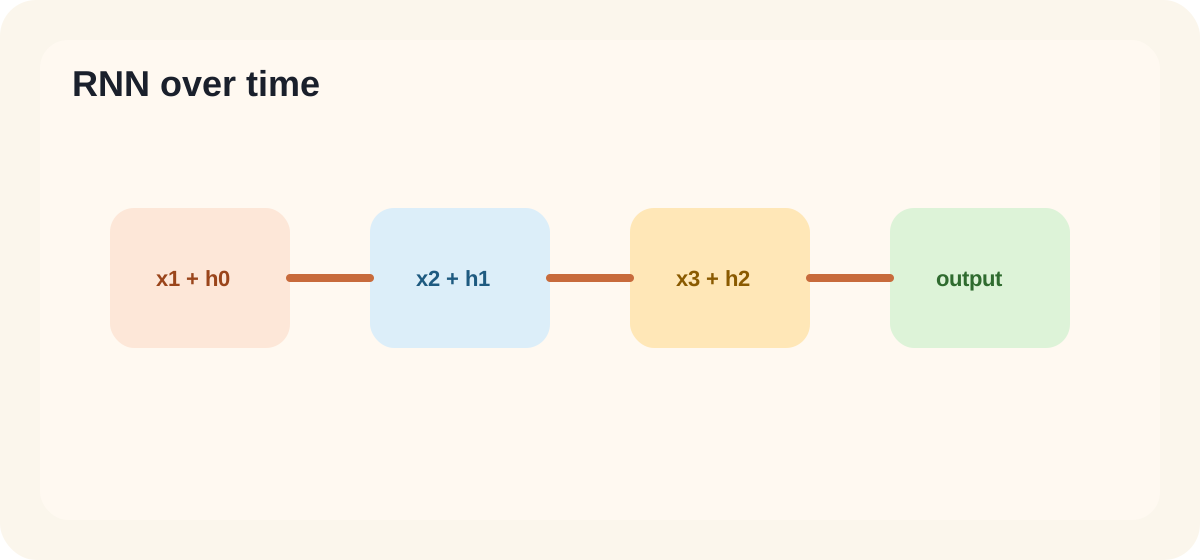
A recurrent neural network is built for sequential data such as text, time series, or speech. At each step, it consumes the current input and combines it with a hidden state carried over from the previous step.
That hidden state acts like a compact summary of prior context, which makes the model different from architectures that process every position independently.
Last updated: May 11, 2026
The main idea
The same cell is applied repeatedly across time. This parameter sharing lets the network handle variable-length sequences while learning how earlier context should influence later outputs.
A simple sequence example
Imagine processing a sentence one word at a time. After seeing the first few words, the hidden state carries a rough summary forward. Each new word updates that summary, which the model then uses to decide what should happen next. This gives the architecture a natural story for ordered data, even if the actual learned state is much less interpretable than a human summary.
Why long-range context is hard
As gradients pass through many time steps, they can shrink or blow up. That makes training difficult and weakens the model’s ability to preserve information across very long sequences.
LSTM and GRU variants were created to improve this behavior, but transformers eventually became much better at scaling long-context sequence modeling.
Why LSTM and GRU variants were important
Vanilla RNNs struggled to decide what to keep and what to forget over long sequences. LSTM and GRU architectures introduced gating mechanisms so the network could control state updates more deliberately. They did not solve every sequence problem, but they made recurrent models practical for many tasks before transformer architectures took over.
Where RNNs fit historically
- They were important for early sequence modeling in language and speech.
- They introduced the intuition of state carried over time.
- They are still useful conceptually even though many frontier systems now prefer transformers.
Common confusion
- RNNs do not remember past inputs perfectly; the hidden state is compressed and lossy.
- LSTMs and GRUs are specialized RNN variants, not unrelated models.
- Sequence modeling did not begin with transformers; transformers replaced a lot of prior recurrent work.
Why this architecture still matters
Even if many modern products use transformers, RNNs remain useful for understanding the history of sequence modeling. They explain why hidden state, recurrence, teacher forcing, and long-range dependency problems became such important ideas in machine learning.