How CNNs Work
CNNs detect local patterns and combine them into higher-level visual features
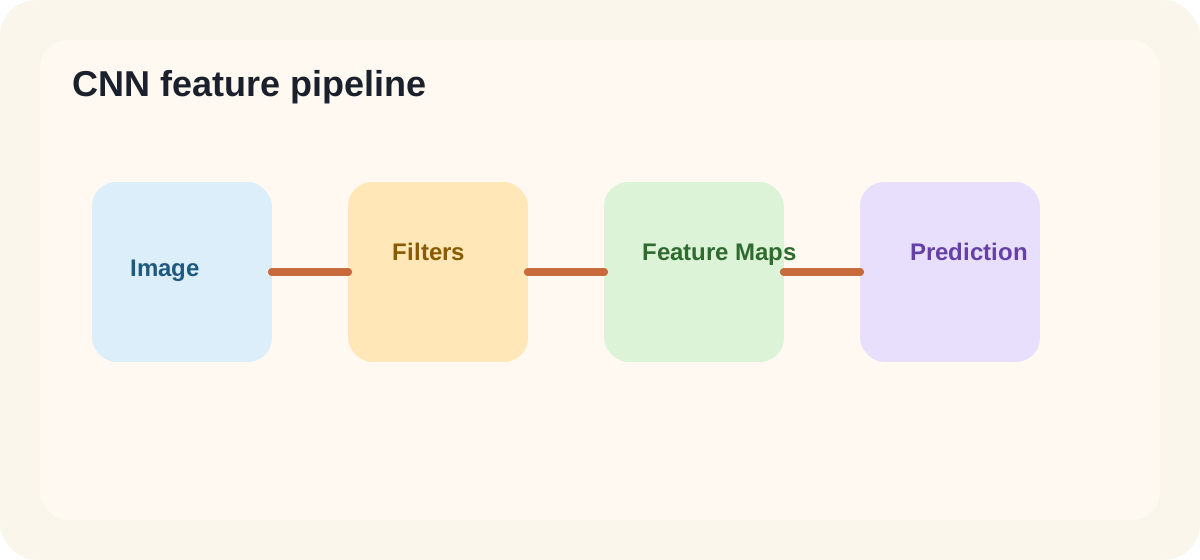
A convolutional neural network is designed for grid-like inputs such as images. Instead of treating every pixel independently, it applies small learnable filters across the image to detect useful local patterns like edges, corners, and textures.
As the network gets deeper, those simple patterns can combine into larger shapes and object-level features.
Last updated: May 11, 2026
The core mechanism
A filter slides across the input and computes a response at each position. The result is a feature map showing where that learned pattern appears strongly.
Different filters specialize in different patterns, and stacking many layers lets the network build a hierarchy of representations.
How features build up layer by layer
Early layers often learn simple patterns such as edges or color transitions. Middle layers combine those into corners, textures, or recurring local shapes. Later layers can respond to larger structures such as object parts. This staged representation learning is why CNNs were so effective on image tasks long before today’s large multimodal systems.
Why pooling was used
Pooling layers reduce spatial resolution while preserving strong signals. This lowers compute cost and helps the model focus on whether a feature exists rather than exactly where every pixel sits.
Training and inference in vision tasks
During training, the model repeatedly sees labeled examples and adjusts its filters so useful patterns produce stronger signals for the right classes or outputs. During inference, those learned filters stay fixed and the network simply computes a prediction for the new image. That distinction matters because a model can be fast at inference even if training was expensive.
Why CNNs were effective
- They reuse the same learned filters across the whole image.
- They respect local spatial structure instead of flattening everything too early.
- They scale better than fully connected layers on raw images.
Common confusion
- A convolution filter is learned from data; it is not manually coded for each class.
- CNNs are not limited to classification; they have been used for detection, segmentation, and more.
- Transformers have become stronger in many vision settings, but CNN ideas are still foundational.
Where CNN ideas still appear
Even in systems where transformers dominate, CNN intuition still matters. Many developers first meet learned visual features through CNNs, and convolution-based building blocks still show up in image processing, embedded vision models, and hybrid architectures where local spatial bias remains useful.